          |
 |  | |
| Español |
Currently only excerpts & illustrations from the last 13 issues (numbers 43 to 55) are on this site. Scroll down to view the June 1997 issue. Click on the numbers to view other issues. Info about the current book on the arts | |||||||||||||||||||||||||||||||||||||||||||||||
| | ||||||||||||||||||||||||||||||||||||||||||||||
|
A listing of the contents 1992 - 2002 >> (numbers 19 - 59) |
Contents List | ||||||||||||||||||||||||||||||||||||||||||||||
|
| excerpts & illustrations (The full articles are only available in the printed magazine. Click on "subscribe" for more info.) |
 |
 |
 |
| ||||||||||||||||||||||||||||||||||||||||||||
|
56 | |
55 | |
54 | |
| |
53 | | 52 | |
51 | |
|
|
50 | |
49 | |
48 | |
47 | |
| | | |
| ||||||||||||||||||
 |
 |  |
 | ||||||||||||||||||||||||||||||||||||||||||||
| 46 | |
45 | | 44 | |
43 | | |
| 42 | | 41 | | 40 | | 39 | |
| 38 | | 37 | |
36 | | 35 | |
| |
34 | |
33 | | 32 | | 31 | | |||||||||||
|
This page is under construction - some material is here. |
pages 2 - 4 Letter from:Bob Charnes, U.S.A.
|
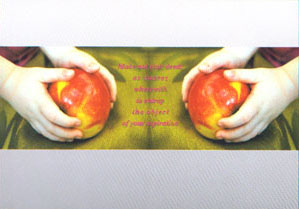 Give and Take by Sonja van Kerkhoff, 1995. The text "Make not your deeds as snares wherewith to ensnare the object of your desire" comes from the Kitab-i-Aqdas by Bahá'u'lláh. One of the works in the Shopping Trolley Art Gallery. | Letter from:Sonja van Kerkhoff, The Netherlands, |
One highlight, apart from the trolley’s various street and gallery appearances, was its temporary
confiscation for use outside the Institute of Contemporary Art in London! The trolley was wheeled up and down in
front of some of the most exclusive galleries in London, and it will soon take a trip through the tunnel to Calais
(France) for a shopping spree. A small gallery show is usually tied to a particular theme or place,
but in this case the trolley’s changing location continually affected the context of the work it displayed,
and put art on the move.
´Art is an antidote for violence. It gives the ecstasy, the self-transcendence that could otherwise take the form of drug addiction, or terrorism, or suicide or warfare. We have seen that both violence and art -and the beauty which is the center of art- yield the experience of ecstasy and self-transcendence. But art and violence are directly opposite in their effects.´ Psycho-therapist and author, Rollo May, in his autobio-graphical book, My Quest For Beauty.
|
Much religious art was also in collusion with state power, and thus played the role of a handmaiden for ideological oppression (not so close to the idea of transcendence, but more intimate with the powers that be. There are rewards for such art. Today the rewards come from corporate sponsors more powerfully than the state). Even on the seemingly innocuous level of “monuments” or “memorials” I would venture to say that there are violent monuments (of hero worship or state glorification). In Germany, there is a heated controversy over the construction of a massive Holocaust memorial in the center of Berlin, and many think the archi-tectural plan for this massive thing is preposterous. Some of you may also have seen the Israeli-Palestinian theatre production and film of Balagan, which treats very critically the use or instrumentalization of memory in contemporary Israel, in a performance that is quite violent and aggressive but justifiably so because of the profoundly unsettling and incomprehensible subject matter of the Holocaust. Remembering can be violent, as we see in the occupied territories.
I don’t know whether it is alright to say that violence in art is sometimes necessary. There have been performances and body art works that were also self-destructive or self-lacerating, and the violence as a real action asked questions about the daily violence we know/consume or don’t recognise, as we sometimes become desensitized to it all. In revolutionary terms, there is also a way to think of resistance against oppression as perhaps a necessary violent act of image making (see the guerrillas of MRTA/Tzpac Amaru in Lima, who are occupying the media and drawing attention to the injustices in their country). I suppose there is no valid generalization. There are so many ways to express and to make art.
Letter from:
Justice St. Rain
, U.S.A.
We would all love to believe that the things we love are beyond corruption. As artists, we want to believe that
art cannot be violent, when, of course it can be. I once saw a piece of performance art by a Bahá´í
friend, which was so full of anger and obscenities that I felt personally violated. But our rosey view of our own occupation is more than just naive, it is dangerous. If we believe that art is an antidote to violence, then we may blind ourselves to the violence we may be perpetrating in the name of art. Shoghi Effendi did not warn us about the prostitution of the arts because the arts were beyond corruption, but because we can become blind to that corruption when we egotistically believe that art is somehow more holy and pure than every other occupation.
If art, like any other form of work, is not done in a spirit of service to humanity, then it is not worship, and therefore can be just as violent, corrupt and degrading as any other activity.
Review:
New CD by
Luanne Hightower
, U.S.A.
reviewed by Philip Belove
, U.S.A.
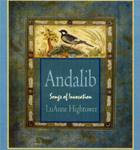 |
The album has range. On the opening cut, prayer, ´Oh Lord My God, Open Thou the door...´ is sung first as an acapela chant and then unfolds into a classic jazz tune. Then the album turns to melodies and arrangements colored by exposure to the brilliant and talented sufi musicians in our area. Bahá´í and Sufi prayers and poems are sung in English and Arabic accompanied by rim drum and Arabian stringed instruments. And these are beautiful arrangments with complex harmonies and they stand as exquisite musical pieces. The Bahá´í selections include The Hidden Word, ´ Love me that I may love thee...´
|
Review: pages 4 - 5
Mevlana: The Whirling Dervishes of Turkey
|
Tina began as an assistant stage designer in her home town of Copenhagen (Denmark) in 1980. Later she worked for the Gladsaxe Theatre as a theatre technician... She then turned to the visual arts... | 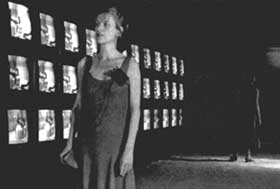
J.Bovenberg and W.Merkx perform Tenminste (if only / at least) by Tina Herslund. |
|
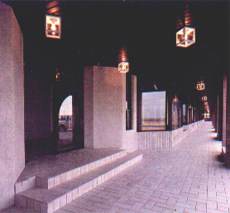 Arcade in the Al Turku Headquarters, Sultanate of Oman. |
LineSync Architecture designs large and small commercial, municipal and residential properties, and currently employs two architects and two draftspersons. Joseph graduated from Harvard's Graduate School of Design with a Master´s degree in Architecture (M.ARCH). Julie is responsible for LineSync Architecture's marketing, client negotiations, and office management. Before running LineSync Architecture, she worked as a professional international educator in third world countries. The family has been living in Vermont for 8 years, where they established LineSync Architecture in 1988.
|
Joseph...In 1983, I began my three year stay in the Sultanate of Oman, working for Al Turki...
|
Julie: I am responsible for the marketing and all the office management. Often our tasks overlap both in design and management, and quite regularly on client relations.
| 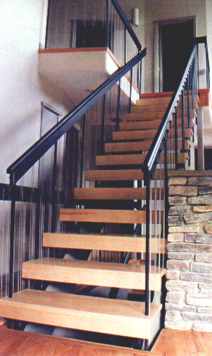 Violin House, Wilminton, Vermont, U.S.A. The focal point is a finely crafted staircase made of fiddleback maple and tightly strung steel cable: a homage to the memory of the widow´s concert violinist husband. |
page 11
Barbara Joyce, visual artist, the Dutch Antilles. |
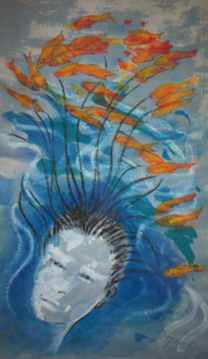 The Dream, painting by Barbara Joyce. |
| |||||||||||||||||||||||||||||||||||||||||||||||||||||||||||||||||||||
|
pages 11 - 12 Andrej Lessovichenko, musicologist, musician, Russia. Lessovichenko is a professor at the Novosibirsk Glinka conservatory. His main field of interest is the relationship between the artist's consciousness and the artist's religious philosophical basis. In 1991, when he became a Bahá´í, he gained new insights into the Christian tradition, which led to his developing another perspective on the history of European music. He talks about this with musicologist Jelena Faal. JF: Andrej, your perspective on European music culture is based on the idea that what is most important is the religious impulse. How does this relate to the existing secular forms of art and to artists with an agnostic perspective? AL: Certainly, there are phenomenon and creative figures who have no connection to religion. You would hardly expect a conscious God-searching moment in the works of Prokofjev or Shostakovitch, and maybe Gounod, Bizet or Grieg. But one thing is sure: every great artist comes across existential problems sooner or later, and starts thinking about the essence of being, and it is at this point, whether the person likes it or not, that the artist expresses opinions and world views that have been formed largely by the culture s/he lives in. These positions, in their turn, have been influenced by the spirit of religion, or more precisely, by the chain of religious systems in which religions replace other religions, and each one leaves its traces. If you look at it this way, you can interpret all artistic expression as being the result of religious consciousness - although, one must also take into account the individual artist´s contributions... |
Poemspage 14 Translation of O Nightingales by Bahá'u'lláh by Juan Cole, U.S.A. page 15 STORM AT WINTER'S ENDING We thought it past -the worst of it at any rate, thought safe to assume relaxed positions, mocked safety measures, cited the sky's brightness as proof of our claim but that was just ploy -ours and the storm's, for it was but hiatus, strength gathering for the thunder to come -and it did! What then -to what avail our strategies? What could we firmly erect against it? Language being the life I have chosen we talked the night through 'till the storm outdid its own and our alarm. How nature vivifies the times and crisis of the race. At almost winter's ending well could we ask: 'By spring what will remain, what of the once approaching comet's kiss?' Daily the Sun-King dies. In stone and tree, as in all life, each is urged to see renewal impelled by cycles of the dying year of which the spring is celebrant. "Be! and it is" the Primal Word declairs, celebrates the death-in-life of human state. My death confirms compulsion to comply, renews the storm-kissed, once reluctant. by Martyn Burke, Belgium. |
Marianne Westeneng Artist Profile pages 12 - 13 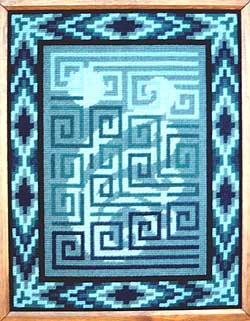
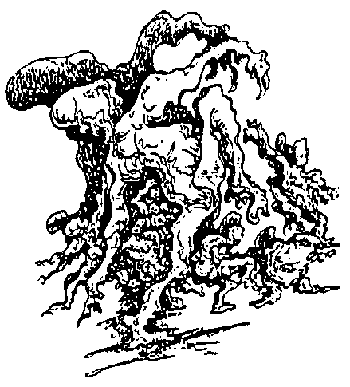
|
|
The Healing for Amanda Do you remember telling me you have babies living in your stomach? They talked to you at night, frightened you, and when your tummy hurt you cried, "My babies are kicking. They want to be born." We learned it was milk that pained you, milk that burned your stomach and clogged your throat with phlegm. And we learned, as you begged us to let you drink it, how desire intensifies for the things that harms us. Do you remember how you stared at the faces of the lost children on the milk cartons? How many times you asked, "Who are they? Why can't they go home?" as you pleaded every day for milk, till I turned and screamed at you to stop. I pray for your babies - how they fill you like one of those Russian dolls, each fitting inside the body of one whom came before, each having the children of her children within her, all waiting to be born or to be found, and needing to be healed. by Peter E. Murphy, U.S.A. |
|
Articlepage 15 Mirabai: The rebellious Rajput Rani: Part 2by Bill Garlington, U.S.A....What her poetry does do is express these themes in a powerfully personal way that breaks through and beyond a theologically correct, yet emotionally superficial style. Her own feelings of pain and alientaion as a rebellious female in a male dominated culture are no doubt one of the main forces at work here. Her calls to her beloved are not just idealized abstractions but spring from the deep felt pain of her own existence. Throughout her poems Mirabai refers to her impossible marriage to Krishna and all of the pain and joy of self-surrender that this union includes. There are also numerous references to the illusion of existence (maya), the pointlessness of philosophical speculation and the meaninglessness of caste and family identity. For example in one poem she sings: That Dark Dweller in Braj (Krishna) Is my only refuge. O my companion (husband) Worldly comfort is an illusion As soon as you get it, it goes. I have chosen the Indestructible for my refuge Him whom the snake of death Will not devour. My Beloved dwells in my heart I have actually seen that Abode of Joy Mira's Lord is Hari (Krishna), the Indestructable. My Lord, I have taken refuge with Thee Thy slave. |
Photographs and Illustrations of work byMary-Anne Westeneng, New Zealand, Tina Herslund, The Netherlands, Egle' Surkyte, Lithuania, Mikhail Kobyakov, Belarus, Claire Janssen, The Netherlands, Kazimierz Wieckowski, Poland, Keike Twisselmann, Northern Ireland, Sonja van Kerkhoff, The Netherlands, Barbara Joyce, The Dutch Antilles, LineSync Architecture, U.S.A., Annemiek Verstappen, The Netherlands, Ruth Park, Australia.
Kathleen Babb, Japan,
Alison Marshall, Aotearoa / New Zealand,
Steve Marshall, Aotearoa / New Zealand,
Sonja van Kerkhoff, The Netherlands. |

Arts Dialogue, Dintel 20, NL 7333 MC, Apeldoorn, The Netherlands
http://Bahá´í-library.org/bafa email: bafa@bahai-library.com |