




back to the homepageAll material is copyrighted. Click to read the details.find an artistwhat´s going downwho are we and what do we do?
back to the homepageback to the homepagewhat´s new & the site map.read all about itOrdering Back issues of Arts Dialoguesubmit material / help with our work
find: Visual Arts New Zealand
BAFA © 2007. All material here is copyrighted. See conditions above.

Mary-Anne Westeneng     textiles, painting, New Zealand.


Please email bafaOMIT THE TEXT IN CAPITALS@bahai-library.com the titel, year and materials for this work.


I became a Bahá´í ten years ago, and it was not long after this that, for health reasons, I gave up the career I was pursuing and had to look at other options. It was not an easy task; I was limited by the fact that I needed to work from my home. Between feelings of despair, I looked at playing the guitar and fictional writing. I enjoyed these, but could not develop them as a career. Then came an overwhelming desire to draw and paint. After I had created a few paintings, I decided to change the medium and work with wool hand-stitched into canvas. This enabled me to better develop the style I began in my paintings. I have worked consistently on tapestry for the past four years, and very few days go by without my needle stitching away. The house I am living in at the moment is on the outskirts of Dunedin, so I’m surrounded by fields, birds, trees, farm animals and bush. It is a really wonderful environment to work in as my soul is soothed, allowing the ideas and inspiration to have a less rocky road to come through. More often than not, the path is not as clear in the city. I enjoy the stimulation of the city -the people, the art, the music, the learning -and I need it and am grateful for it, but when I am working, the quiet and freshness is better.

In my work I have a great desire to reach out to people with the spiritual, so many of my pieces involve -in largely symbolic terms - the teachings of Bahá’u’lláh. I am also strongly influenced by the Maori people, as the spiritual aspects of their culture reaches my heart too.

In one of my works called The Burning, I have used the colours often associated with Maori art -black, red and white. In this work, black signifies the nothingness and the darkness, red, the chaos and confusion, and white, the enlightenment. Together, the colours talk of coming out of nothingness, and growing through the chaos and confusion to reach the enlightenment. Against a black background, I have the stylised body in red, with white in its head. This represents the painful and enlightening journey of the lifting of veils. The body is writhing and burning as it frees itself from its burden. My ancestry also speaks through my works. My father comes from Holland, which I think is what draws me to the blue and white colours I often use, and from my mother comes the Irish, Scottish, French and Spanish. I feel that my Irish and Scottish ancestry is, in some instances, very similar in form and idea to that of the Maori culture.

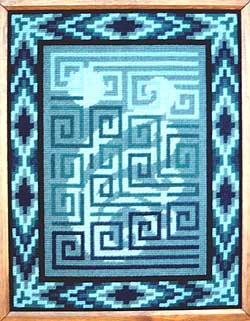
In Blue Moon, the colours are white and different shades of blue. The symbols come from both the Celtic and Maori meaning of life and growth, which I have stylised into a contemporary design. I have used the white Koru to express the two orbs of male and female joining together in harmony, peace and strength, under the influence of the moon and its two rays - the pillars of consultation and compassion. Many of my pieces are produced in earthy tones...

Arts Dialogue, June 1997, Page 12 - 13.


Arts Dialogue, Dintel 20, NL 7333 MC, Apeldoorn, The Netherlands
email: bafaOMIT THE TEXT IN CAPITALS@bahai-library.com